
On this page
The sheet that got you here
Credit where it's due. A spreadsheet with style code, size, cost and sale price will carry a one-person operation surprisingly far. It's free, it's yours, and you can bend it into whatever shape you need. Plenty of good shops ran on one for years.
The trouble is that a sneaker business doesn't grow in a straight line. It grows sideways. First there's a Shopify store next to the Instagram DMs. Then a consignment shelf. Then a physical shop, a part-timer on Saturdays, maybe a second location. Every one of those adds another place where a pair can live and another person who can sell it. The sheet was never built for that. It was built for you, sitting at one desk, remembering everything.
You'll know you've hit the limit when someone asks "do we have the 44?" and three people give three different answers.

Where it actually breaks
The size 43 that sold twice
Drop day, Saturday, early afternoon. The shop is full, the website is live, and there's exactly one pair of a model in size 43. A customer pays for it at the counter. Eleven minutes later, somebody else buys the same pair on Shopify, because nobody had a spare second to change the stock count from 1 to 0.
Now you get to refund a stranger, write an apology, and possibly hunt down another pair at a worse price. In most retail, a double sale is an annoyance. In sneakers, where one size is often one unit, it's a lost customer.
It isn't carelessness. The stock lives in four places at once (the sheet, the website, the shelf and somebody's head) and they only agree when a human stops to make them agree. On a busy day, nobody stops.
"Hey, did my pair sell?"
Consignment is brilliant for range and terrible for spreadsheets, because now you're tracking stock you don't even own. Each pair needs an owner, an agreed payout, an intake date, a sale date and a "paid or not" status.
What usually happens is a tab in Excel, a note called "consign prices FINAL v2", and a dozen WhatsApp threads. Then a consignor messages at 10pm asking if their pair sold, and you're scrolling through three apps to answer a yes-or-no question. Do that often enough and the good consignors, the ones with the pairs everybody wants, quietly take them somewhere that answers faster.
Two shops, one guess
A second location sounds like double the stock. In practice it often means double the confusion. A pair gets moved to the other shop by text message. A customer is told the size is "at the other store" and it isn't. The Monday count never matches the Friday count, so someone spends a morning walking shelves instead of selling.
Repricing at midnight
A lot of shops price off StockX and then add their own logic: a markup, a fixed amount on top, a rounding rule so prices look clean. Doing that by hand means opening the market price, doing the maths and updating your site, pair by pair, size by size.
So it happens late at night, on a phone, half asleep. Or it doesn't happen at all, and you end up either underpriced on the pairs that are moving or overpriced on the ones collecting dust. You know how to price. The problem is that your rules live in your head instead of in the thing that actually publishes the price.
One record per pair
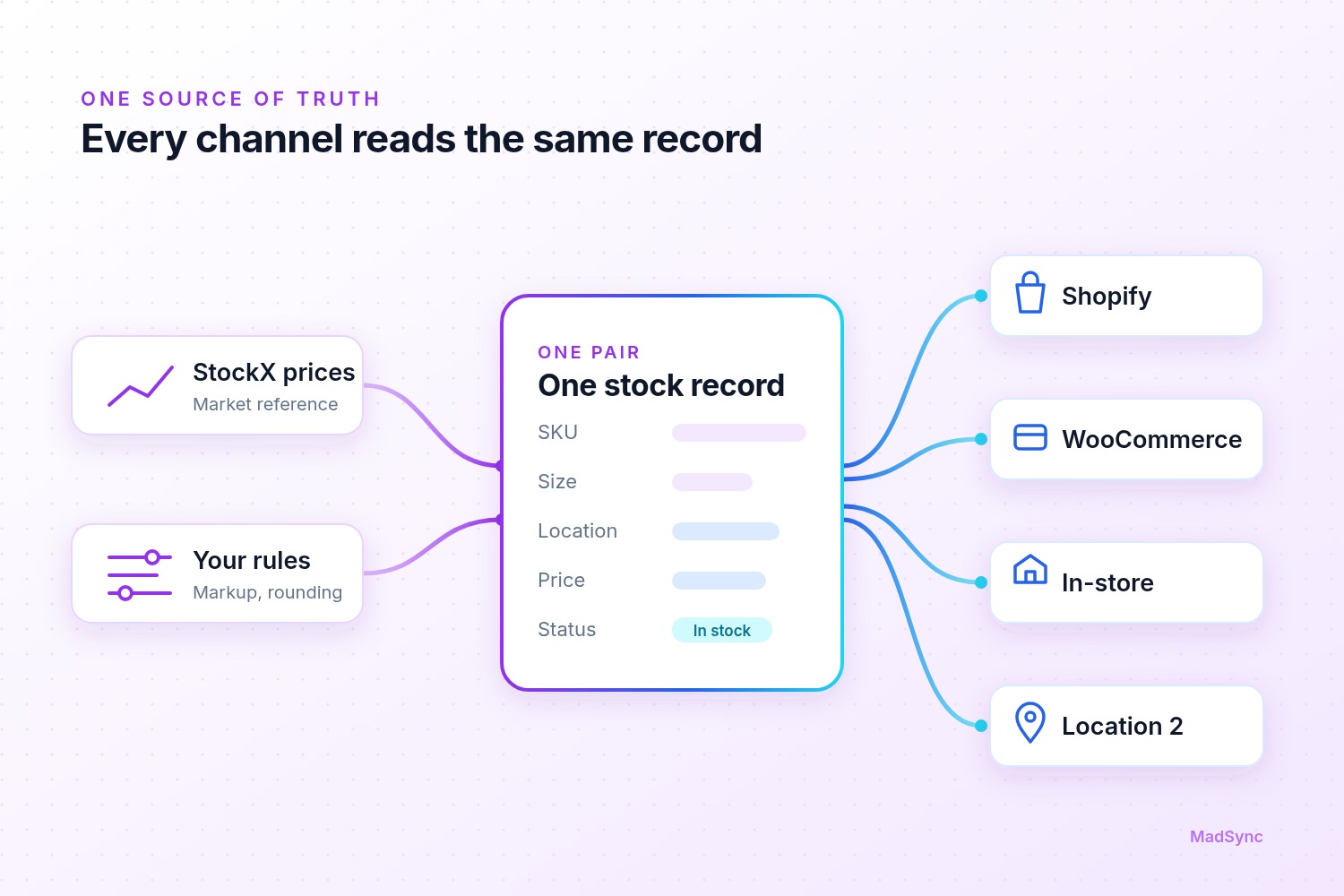
The fix isn't a cleverer spreadsheet. It's a different habit: every physical pair gets exactly one record, and every channel reads from that record. The website, the counter and the consignment payout all look at the same row.

That record needs to know a handful of things. What the pair is: style code, colourway, size and condition. Sizes need to be consistent too, because a sheet that mixes EU, US and UK sizing is a sheet that will eventually sell the wrong pair. If two pairs look the same but one has a damaged box, they're two records.
It needs to know who owns it. If it's consigned, the consignor and the agreed payout sit on the record itself, not in a separate tab. When it sells, you already know what you owe and to whom.
It needs to know where it is, in one place at a time. Moving a pair to the other shop is something you record, not something you text about.
It needs a price that comes from somewhere. A market reference like StockX, plus your rules written down once, for example market price plus 20%, plus €10, rounded. Then prices follow the market through automatic price updates instead of your midnight sessions.
And it needs a status. In stock, listed, reserved, sold, returned. When the pair sells at the counter, the status changes once and the website sees it too. That's the bit that kills the double sale.
Getting off the spreadsheet without losing a weekend
You don't need a big migration. You need a sensible order.
- Clean the sheet before you move it. One row per physical pair, not "Dunk Low x3". Pick one size format and stick to it. Add an owner column so consigned pairs are obvious. Whatever mess you import, you keep.
- Do one proper count. Pick a quiet weekday morning, close the door for two hours if you have to, and count everything. That count is your starting point. Don't import numbers you don't trust.
- Connect your online store first. The biggest win is the website and the counter reading the same stock. If you're on Shopify or WooCommerce, that's step one, before you touch anything fancy.
- Write your pricing rules down. Markup, fixed amounts, rounding, and what you do differently for hyped releases. If you and your business partner disagree, better to find out now.
- Move consignment in one go. Half your consignors in the new system and half in the old sheet is worse than either. Pick a date, move them all, and tell them where to ask.
- Kill the old sheet on a set date. Rename it "ARCHIVE, DO NOT EDIT" and lock it. If it stays editable "just in case", someone will keep updating it, and you're back to two versions of the truth.
A spreadsheet looks free, but it isn't. You pay for it in refunds, in prices that lag the market, and in Saturday afternoons spent recounting shelves instead of selling. The shops that scale aren't the ones with the best formulas. They're the ones that stopped treating stock as a list.
Where MadSync fits
We built MadSync for shops in exactly this spot. It's an ERP for sneaker resellers and shops: inventory by SKU and size, stock across multiple locations, Shopify and WooCommerce sync, and StockX-based pricing with your own rules applied automatically (GOAT is coming soon).
If your spreadsheet has started to feel like a part-time job, have a look at how MadSync works. And if you're not there yet, the steps above still apply. One record per pair is the habit that matters, whatever you use.