Black Friday is a week now, not a day
The numbers keep pointing the same way. Salesforce expects Cyber Week, which it counts from Tuesday 24 to Monday 30 November, to bring in a record $357 billion in online sales worldwide, up 6% on last year. It also found that nearly 70% of shoppers are holding out for Cyber Week to make big purchases, and that retailers are starting the season with discounts about 5% deeper than a year ago.
Independent shops get a real slice of that. Last year, Shopify merchants did a record $14.6 billion over the Black Friday to Cyber Monday weekend, up 27%, and sales peaked at $5.1 million a minute around midday US Eastern time on Black Friday itself.
Two more details matter for sneaker shops:
- Most orders come from a phone. In the US, 57.5% of Cyber Monday online sales in 2025 were made on a mobile device, according to Adobe. Your product page has to look right on a small screen, crossed-out prices included.
- The counter still matters. Salesforce says 71% of shoppers plan to shop in store this season, and one in three Gen Z shoppers plans to turn up for an early-morning Black Friday deal.
Sneakers don't behave like the rest of retail, though. You usually have one pair per size, and the price is set by the resale market, not by a label on the box. When big retailers mark down general releases, resale prices on those models tend to soften too, while hyped pairs often hold. So the job isn't "discount everything". It's knowing which pairs to push and which to leave alone.
What's trending going into Black Friday
Here's what's trending in the market over the past 30 days, from 22 October to 20 November, based on anonymous, aggregated trends. A few pairs tell most of the story.
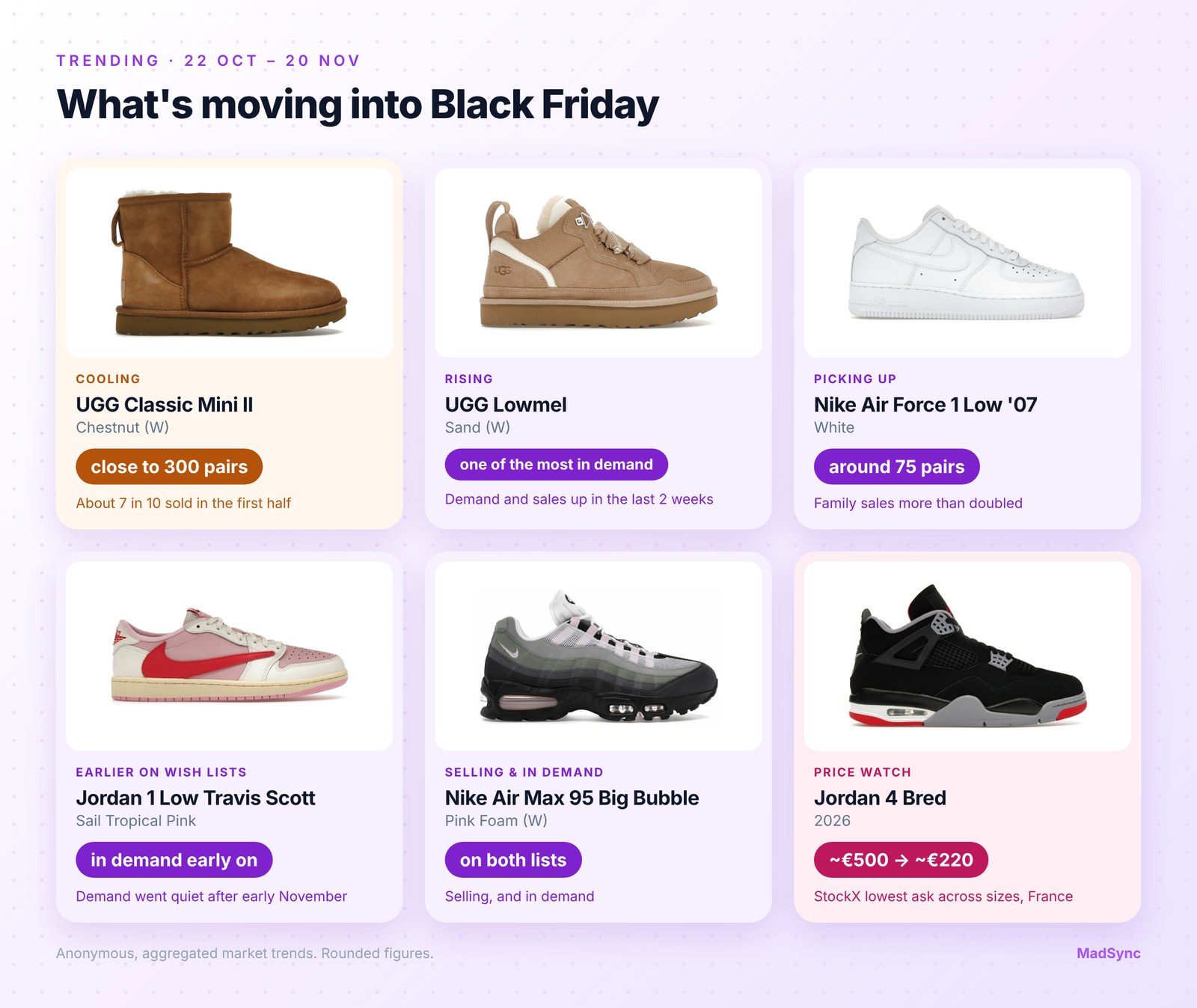
UGG minis peaked early. Classic Mini and Ultra Mini boots came to nearly 580 pairs sold, with the Classic Mini II in Chestnut at close to 300 on its own, and about three in four of them sold in the first half of the period. The last two weeks were much quieter.
The UGG Lowmel is taking over. The women's Lowmel in Sand was one of the most in-demand pairs of the period, with around ten buyer requests, most of them in the last two weeks. Its sales picked up over the same stretch. If you're thinking about an UGG restock, this is the one to look at before more minis.
Air Force 1s are picking up. The family came to a little over 120 pairs, around 75 of them the white Low '07, and sales more than doubled in the second half of the period. It's the classic gifting pair, and it's heading into Black Friday with momentum.
Earlier on the wish lists: the Travis Scott Jordan 1 Low in Sail Tropical Pink was one of the most in-demand pairs early in the period, though demand went quiet after the first week of November. The women's Air Max 95 Big Bubble in Pink Foam made both lists, selling and in demand.
One to watch on price: across sizes, the typical StockX lowest ask in France for the 2026 Jordan 4 Bred went from around €500 to around €220 in about ten days, around its 17 November release, and it has stayed there.
What that means for your weekend: keep the Air Force 1s and Lowmels stocked and visible, don't discount what's already moving, and check the ticket on anything that's cooling before a customer does it for you.
Turn your in-store prices into a real Shopify sale
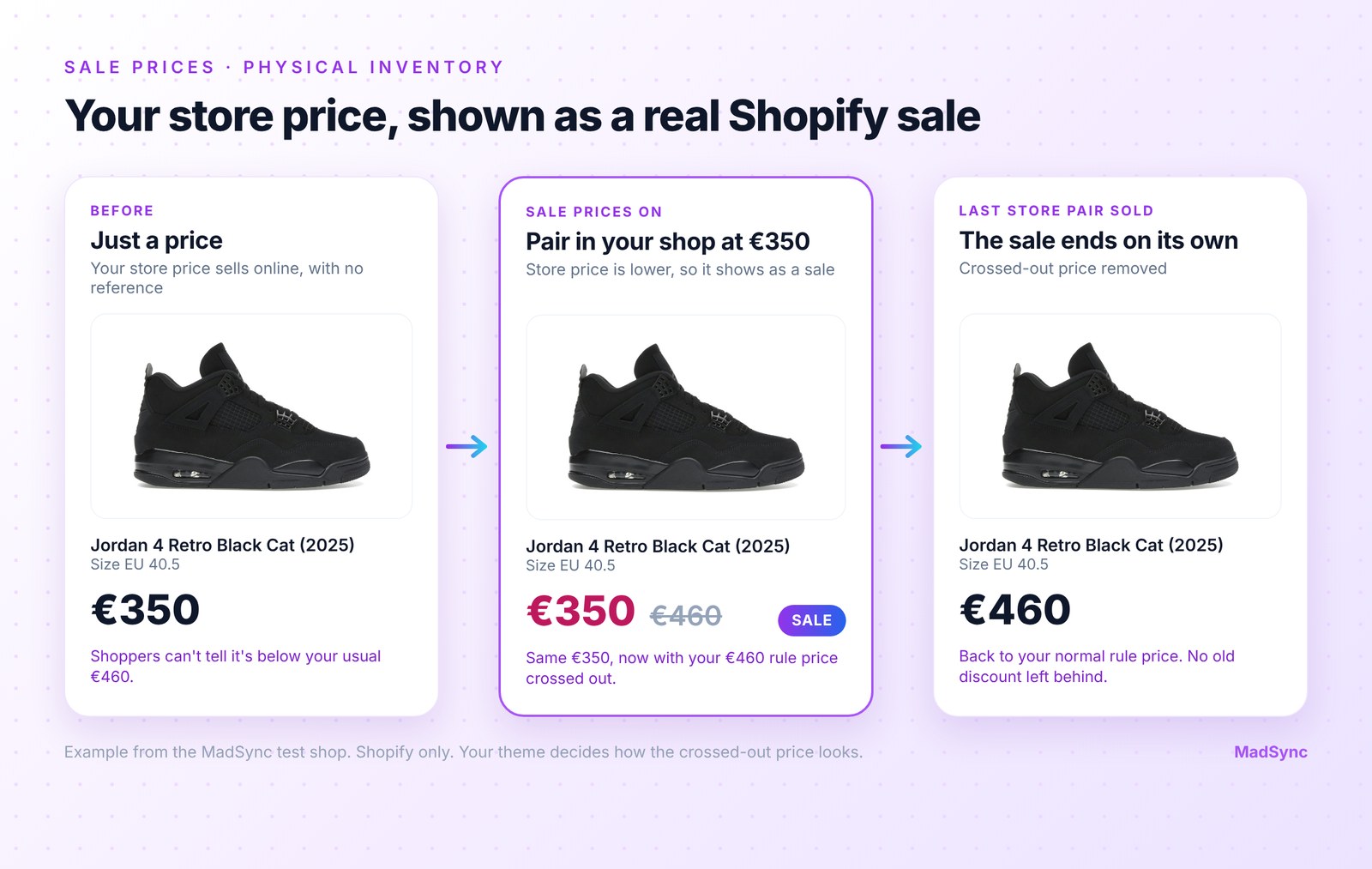
Here's a situation most shops know. A pair is in your shop at €350, so that's also the price your Shopify store charges for it. But your pricing rule would normally list that size at €460. Online, shoppers just see €350. They have no idea it's €110 below your usual price, and on Black Friday that's a deal you're not getting credit for.
MadSync's new Sale prices option fixes that for Shopify stores. It shows your in-store price as the selling price on Shopify, with your normal price crossed out next to it, the way shoppers expect a sale to look.
To switch it on:
- In MadSync, open Physical Inventory and click Sale prices in the toolbar.
- In the Inventory sale prices window, turn on Show physical stock as sale prices.
- Click Save. MadSync refreshes your Shopify store in the background, and sale prices appear as it goes.
How it behaves:
- MadSync never invents a reference price. The crossed-out price is the price your pricing rule would normally set for that size.
- It only shows when your store price is lower. If the store price is higher than the rule price, nothing changes.
- New pairs only. Used stock isn't included.
- No stacking. If a product already has a promotion running, MadSync leaves it alone. A compare-at price you set yourself in Shopify is kept too.
- Display only. It doesn't change your prices or your stock. It only adds the crossed-out price on Shopify.
The part you'll like on a busy weekend: the sale ends on its own. When the last store pair in a size sells, or you switch the option off, MadSync removes the crossed-out price it added and that size goes back to your normal rule price. No old discount hanging around on a pair you no longer have.
Good to know: Sale prices works with Shopify stores only for now, not WooCommerce. And if you sell to customers in the EU, a crossed-out price counts as announcing a price reduction, so the "was" price should be the lowest price you charged for that pair in the 30 days before the sale started (EU guidance). If a pair has already been selling online at its store price, check with your adviser before showing a higher crossed-out price to EU shoppers.
Your Black Friday checklist
Pricing: set your floor before Friday
Work out the lowest price you'll accept on each pair before the weekend, including your cost, fees and shipping, not at 11pm on Friday. Then decide where discounts go. Pairs that are cooling, or where the market has already dropped, are the ones to move. Pairs that are picking up don't need a discount to sell. If your pricing follows StockX through rules, check those rules once this week so a fast-moving market doesn't drag a price somewhere you didn't plan.
Stock: one count, every channel
Do a proper count before Wednesday, while it's still quiet. During the weekend, record every in-store sale as it happens, so your online stock follows. In MadSync, Mark as sold in Physical Inventory updates your online stock and price straight away, so the same pair can't be bought online a minute later. Don't set a lot's quantity to zero to "sell" it. Use the sale itself, so the record stays right.
Fraud and returns
Big weekends bring risky orders. Take a second look before shipping anything high-value to a new customer, especially when the billing and delivery addresses don't match or the delivery address is a parcel locker. Shopify's built-in fraud check on each order is a good first look. Photograph expensive pairs and their boxes before they go out, and ship them tracked and signed for. For online orders in the EU, customers generally have 14 days from delivery to withdraw from the purchase, so make your return conditions clear on the product page and at checkout.
Shipping cut-offs
Plenty of Black Friday buyers are buying gifts. Check your carriers' holiday cut-off dates now and show them on your site, with a few days of buffer. Missing a promised delivery costs you more than the sale was worth.
Consignment
If you sell consigned pairs, talk to your consignors before the weekend. Agree in writing whether a pair can be discounted, and the minimum payout they'll accept. Nobody wants that conversation after the pair has sold.
Cash flow
Black Friday money arrives fast, and so do restock temptations. Before you reorder, check what actually sold and what's cooling. Restocking on a family that peaked a month ago is how you start January with a full stockroom and an empty bank account.
Where MadSync fits
MadSync is an ERP for sneaker resellers and shops: inventory by SKU and size, stock across locations, Shopify and WooCommerce sync, and pricing based on StockX with your own rules applied automatically. Sale prices is available now in Physical Inventory for Shopify stores, just in time for the weekend.
If you want your counter, your website and your prices to tell the same story this Black Friday, take a look at how MadSync works.